Three Gorges Dam: how physics dictated every hard decision
A technically grounded case study of the Three Gorges Dam (1994–2012): why the 2,335-m-wide valley forced a concrete gravity dam rather than an arch, how 9,500 km of embedded cooling pipe kept a 27.2-million-m³ pour from cracking itself apart, how 32 × 700-MW Francis turbines scaled runner diameters to world records, and why 22 km³ of flood storage and sediment management have required a cascade of four additional mega-dams upstream — plus 2025 peer-reviewed seismic data and the NDRC-approved second ship lock channel.

In 1919, Sun Yat-sen proposed a dam at the Three Gorges that could generate 30 million horsepower — approximately 22 gigawatts. Nearly a century later, the completed structure came in at 22,500 MW. 1 That convergence is either an extraordinary coincidence or evidence that the hydraulic potential of the Yangtze at that location is so physically determined that two engineers, working 75 years apart, were bound to land in the same range once they did the math.
The physics that made the power estimate reproducible also made the engineering decisions less discretionary than they might appear. The valley was too wide for an arch dam. The concrete volume was too large to pour without thermal management at industrial scale. The 113-meter head differential between the upstream and downstream pool was too large to navigate by any method short of a five-step ship lock — or a vertical elevator for smaller vessels. And the sediment load entering a reservoir that slows the Yangtze to near-stillness for 660 km upstream was large enough to require, eventually, a cascade of four more mega-dams on the upstream river just to manage what flows into the Three Gorges reservoir.
What follows is an account of those constraints and the engineering choices they forced.
From flood memorial to construction site: 1919–1994
The political case for a Yangtze dam was built on a single catastrophic event. In 1954, floods inundated 193,000 km² of central China, killed 33,167 people, displaced nearly 18.9 million, submerged Wuhan for three months, and severed the Beijing–Guangzhou railway for over 100 days. 1 2 The disaster converted the dam from an engineering proposal into a political mandate.
Mao Zedong made that mandate explicit in 1956, swimming in the Yangtze at Wuhan and writing a poem that called for "A Great Stone Wall, to catch the clouds and rains of Wushan." 1 The poetic vision had a quantitative antecedent: John L. Savage, the U.S. Bureau of Reclamation's chief design engineer, had surveyed the Three Gorges site in 1944 and drafted a preliminary dam layout that brought 54 Chinese engineers to the United States for training. That program was abandoned when the Chinese Civil War ended the Nationalist government's infrastructure plans, but the engineering reconnaissance was not wasted — it established the basic geometry of the site that would eventually be built.
The decision to proceed came on April 3, 1992, when the National People's Congress (NPC) voted on the project: 1,767 in favor, 177 against, 664 abstentions, 25 not voting — a 67.75% approval rate, the lowest margin for any major resolution in NPC history. 1 2 The World Bank refused to provide financing, citing unresolved environmental concerns. Construction began on December 14, 1994.
Why a gravity dam: the valley geometry argument
The first structural decision was also the most constrained one.
A concrete arch dam transfers reservoir water pressure horizontally into the canyon walls rather than resisting it with dead weight. That load path requires two things: canyon walls with sufficient bearing capacity to absorb the arch thrust, and a valley narrow enough that the arch span is geometrically feasible. Arch dams are materially efficient — they use less concrete than a gravity dam of the same height — but only where the geology and topography cooperate.
At the Three Gorges site, neither condition was favorable. The valley is wide — the dam crest runs 2,335 m from abutment to abutment. 1 At that span, the horizontal arch thrust would require abutment rock of exceptional extent and uniformity on both sides. Practical Engineering's Grady Hillhouse has noted that even Hoover Dam — widely called an arch dam — is technically an arch-gravity hybrid, with the gravity component carrying a significant share of the load precisely because the design cannot rely entirely on arch thrust at that scale. 3
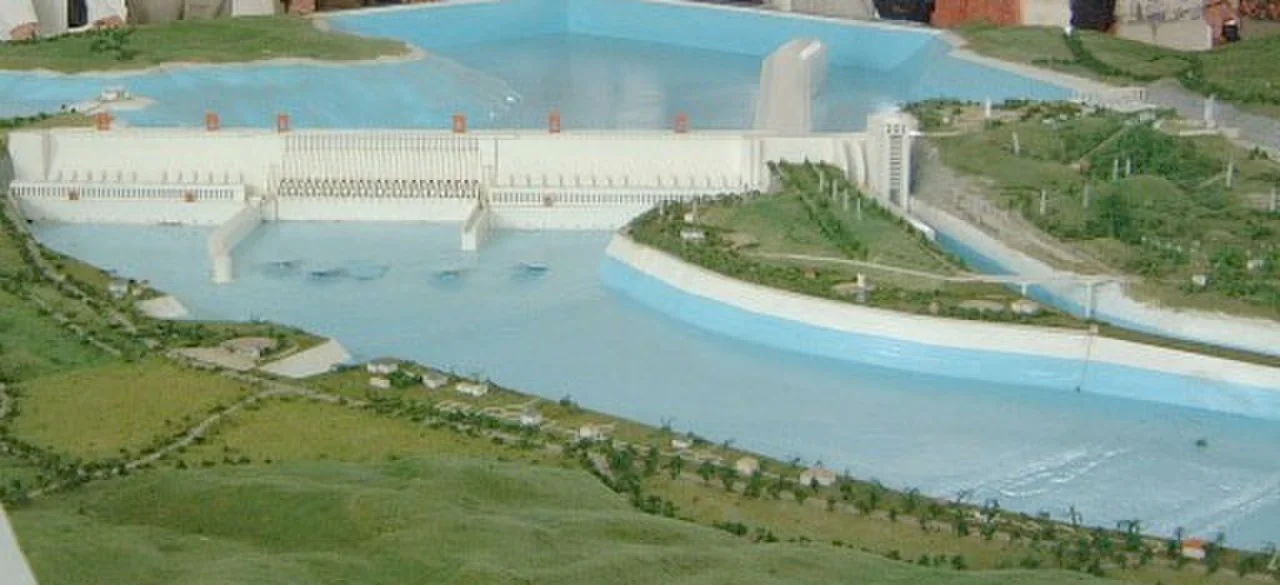
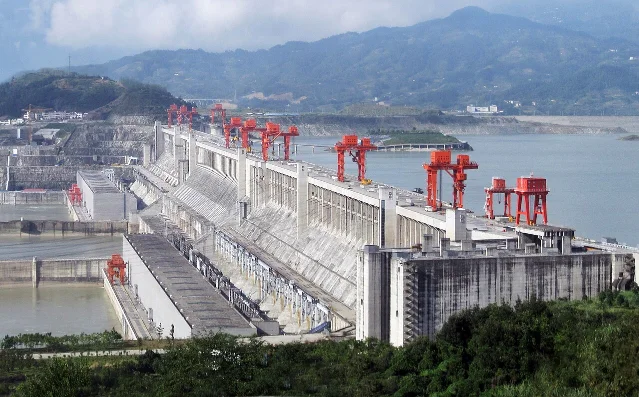
The Three Gorges design team chose a straight concrete gravity dam: a trapezoidal cross-section that resists overturning and sliding through sheer mass. The cross-section is 40 m wide at the crest and 115 m wide at the base, with the concrete structure rising 181 m above rock foundation to a crest elevation of 185 m above sea level. 1 Total concrete: 27.2 million m³ — roughly 11 times the volume of Hoover Dam.
Zhang Boting, deputy secretary-general of the China Society for Hydropower Engineering, cited a further advantage of the gravity form: "the Three Gorges Dam was designed as a concrete gravity dam and would therefore be resistant to nuclear attacks." 1 The reasoning is straightforward — 27.2 million m³ of mass-concrete absorbs localized damage without redistributing load in ways that cause cascading failure, unlike a thin arch where a local breach can propagate to the abutments.
The dam is also instrumented extensively: more than 12,000 embedded sensors monitor bending, seepage, and uplift pressure continuously. 4 A 2024 independent analysis using ESA Sentinel-1 SAR data — repeated-pass InSAR with 12-day revisit — found the dam body to be stable across the observation period, with widespread "no displacement" readings; a small cluster of anomalous data points near a downstream construction area were attributed to image-processing artifacts rather than structural movement. 5 The "dam is visibly bending" images that circulated on social media during the 2020 flood were confirmed to be a stitching artifact produced when Google Earth switches between satellite image sources of different acquisition dates.
Keeping 27 million cubic metres of concrete cold
The structural form determined the concrete volume; the concrete volume determined the thermal problem.
Portland cement hydration is exothermic. In a mass pour, the heat generated faster than it can dissipate through the concrete surface — the interior temperature rises, eventually causing differential thermal expansion between the hot core and the cooler surface. When the core cools and shrinks, the tensile stresses in the concrete can exceed its tensile strength, opening cracks. The problem scales with pour volume: a 27.2 million m³ mass without thermal management would take, by USBR-style calculations, decades to cool to ambient temperature.
The Three Gorges engineers faced an additional difficulty: the dam is in central China, where summer air temperatures regularly exceed 35°C, and the summer months are exactly when construction had to proceed to meet the schedule. Dai Huichao of International Water Power described the situation bluntly: "the low-temperature concrete production system at TGP is the largest in the world and the strictest in terms of temperature control." 6
The solution involved four interlocking measures:
Secondary air-cooled aggregate. Coarse aggregate was first chilled in a ground-level cooling chamber (which doubled as a secondary screening station), then re-chilled in the batching plant bins before mixing. Dai noted this was "a new technique — secondary air-cooled aggregate — was used after a series of tests and studies," without precedent in domestic or international dam construction at the time. 6
Ice and chilled water in the mix. Flake ice replaced liquid water in the mix to absorb heat through the ice-to-water phase transition. The combined system targeted a concrete exit temperature of 7°C at the batching plant outlet — achieved through a closed cold-air circulation loop. Measured results from the 1999–2001 summers: exit temperatures ranged from 1.6°C to 12°C, averaging 6.8°C, with approximately 85% of readings below the 7°C target. 6
Artificial fog. During summer placement, fog generators created an evaporative cooling blanket over the work area, lowering surface temperature by several degrees and blocking direct solar radiation. 7
Embedded cooling pipes. Following the precedent established at Hoover Dam but scaled up substantially, 9,500 km of steel cooling pipes were cast into the concrete — more than ten times the 937 km at Hoover Dam. 7 Chilled water circulated through the pipes until each lift reached thermal equilibrium with its surroundings. The pipes were then pressure-grouted and became permanent passive reinforcement.
The production rate this system enabled was significant. Using tower belt conveyors — a continuous belt system that eliminated the batch-truck delivery bottleneck — crews in 2000 achieved 5.48 million m³ of concrete placed in a single year, with a single-month record of 553,500 m³ and a single-day peak of 22,000 m³. 1 6 All three figures were world records at the time.
Diverting the Yangtze: three cofferdams over 12 years
The construction sequence was itself a major engineering challenge: the Yangtze carries an average flow of 14,000 m³/s, rising to 70,000 m³/s during peak floods. Work had to proceed in a dry cofferdam while the river kept flowing.
The solution was a three-phase program spanning 1994 to 2006:
Phase 1 (1994–1997): A diversion channel was cut through the right bank. The main cofferdam and auxiliary works were built on the left bank to redirect flow, and the existing river channel handled overflow. On November 6, 1997, the main Yangtze channel was closed — massive concrete tetrapods and quarry stone were dumped into the current until the channel was blocked and flow shifted to the purpose-built diversion channel. 1
Phase 2 (1997–2003): Upper and lower cofferdams formed a dry basin on the left bank. The main dam body and left-bank powerhouse were built in this basin. On June 1, 2003, the reservoir began filling; the five-step ship locks opened for trial use; and the first generating unit came online on July 10. 1
Phase 3 (2003–2006): A third cofferdam isolated the right bank. Construction of the remaining dam sections and right-bank powerhouse proceeded in the dry. By 2006 the dam body had reached its design crest elevation of 185 m.
The underground powerhouse — six additional 700-MW units excavated inside the mountain of the right bank — was the final stage, with the last unit commissioned on May 23, 2012. 1
32 × 700 MW: the Francis turbine problem at this scale
Loading stats card…
The 32 main generating units — 14 on the left bank, 12 on the right bank, and 6 in the underground powerhouse — are each rated at 700 MW, making the Three Gorges Dam the world's largest hydroelectric power station by installed capacity at 22,500 MW (plus two 50-MW station-service units). 1
Each unit uses a Francis mixed-flow turbine — the same basic runner geometry used at virtually every large hydroelectric project worldwide, in which water enters radially through the spiral casing, accelerates through adjustable guide vanes, passes through the runner converting kinetic energy to shaft rotation, and exits axially through the draft tube. The engineering challenge was scaling up: at 700 MW per unit, the runners are the largest Francis turbines ever manufactured.
Two international joint ventures shared the manufacturing contract, and their designs diverged on runner diameter. The VGS consortium (Voith + GE + Siemens, paired with Dongfang Electric of China) produced runners with a diameter of 9.7 m; the Alstom consortium (with ABB, Kvaerner, and Harbin Electric) came in at 10.4 m. 1 Both diameters were world records at installation. Each complete unit weighs approximately 6,000 tonnes.
The operational parameters reflect the hydraulic conditions at the site: rated head of 80.6 m, flow rate ranging from 600 to 950 m³/s depending on operating head (higher head requires less flow for the same power), shaft speed of 75 rpm (the rotor carries 80 magnetic poles to generate 50-Hz current), generator outlet at 20 kV stepped up to 500 kV for transmission. 1 Average unit efficiency exceeds 94%, with a measured peak of 96.5%.
Fabian Acker, writing in IET magazine, called each of the 32 turbines "state-of-the-art at the time of their installation." 1 The caveat matters: initial prototype testing revealed severe cavitation-induced vibration that nearly destroyed the runners, requiring multiple design iterations before units could operate at full load. 4 Technology transfer was built into the manufacturing contracts — both joint ventures included a Chinese partner and were contractually required to transfer design knowledge to those partners, establishing a domestic capability that later enabled the manufacture of the even larger units used at Baihetan Dam (16,000 MW, commissioned 2022).
The commissioning timeline stretched across nine years:
Loading chart…
Cumulative installed capacity at Three Gorges Dam, 2003–2012. In December 2007, the 17th unit brought the total to 14.1 GW, surpassing Itaipu's 14.0 GW and making Three Gorges the world's most powerful hydroelectric station. 1
Full-capacity operation from 2012 onward produced annual output well above design expectations in favorable hydrology years. The 2020 record of 111.8 TWh — driven by exceptionally heavy monsoon rainfall — broke Itaipu's previous world record of 103 TWh (set in 2016). 1 The 2012–2021 average was 97.22 TWh/year, compared to Itaipu's 89.22 TWh over the same period.
One number that complicates the energy narrative: at 9,852 TWh of total Chinese electricity demand in 2024, Three Gorges' output that year — roughly 82.9 TWh — represented less than 1% of national consumption. 1 The dam was originally projected to supply 10% of China's electricity. China's demand grew faster than the engineers who justified the project's economics in the 1980s anticipated — a reminder that the economic case for infrastructure at this scale depends on demand forecasts that are essentially political documents.
Five steps up: the 113-metre ship lock problem

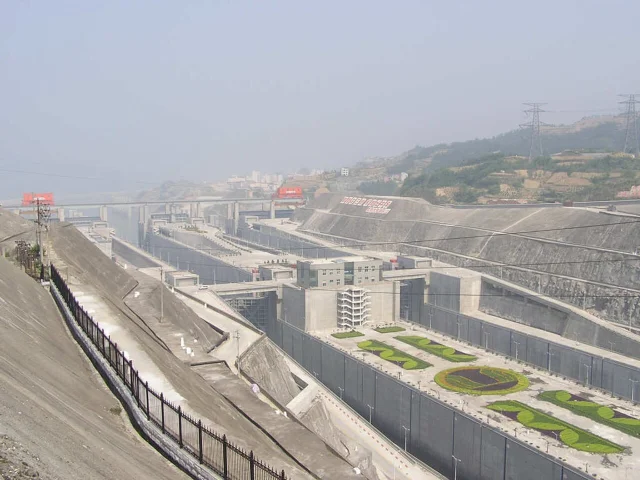
The reservoir raised the upstream water level by up to 113 m relative to the downstream river. Every vessel that had previously moved freely along the Yangtze now faced a vertical barrier. The engineering solution — two parallel five-step ship lock staircases — is, in the dry description of specifications, a sequence of ten water-filled chambers. In practice it is a machine that lifts a 10,000-tonne vessel 37 stories using nothing but gravity-fed water transfer.
Each of the five lock chambers is 280 m long, 35 m wide, and 5 m deep — capable of handling four 3,000-tonne vessels simultaneously, or a single 10,000-tonne ship. 1 The staircase arrangement uses intermediate gates that serve dual function: each gate is simultaneously the upper gate of the chamber below and the lower gate of the chamber above. Water fills or drains between adjacent chambers by gravity without pumping. A full passage through all five steps takes approximately four hours.
The two parallel lines provide independent upbound and downbound transit, eliminating the delays from two-way traffic at a single-lane lock. Before the dam, the Three Gorges section carried a maximum annual freight throughput of roughly 18 million tonnes. By 2022, annual throughput through the locks reached 159.65 million tonnes, growing at roughly 6% per year. 1 SASAC (China's State-owned Assets Supervision and Administration Commission) reported 2025 lock throughput at 173 million tonnes. 8
That success has produced a different problem. Wait times for vessels to transit the locks climbed from 17 hours in 2011 to more than 200 hours — over eight days — in 2024. 9 The locks are operating at roughly 140% of their design throughput. In May 2025, China's National Development and Reform Commission (NDRC) approved the "Three Gorges Water Transport New Channel Project": a second set of dual five-step locks with chambers measuring 6,680 m × 40 m × 8 m — wider and deeper than the original, capable of handling larger and more fully loaded vessels. 9 NDRC projects the over-lock demand will reach 230 million tonnes by 2030 and 260 million tonnes by 2050 against a maximum original lock capacity of 170–180 million tonnes.
Loading link preview…
The ship lift: a 34,000-tonne vertical marine elevator
For vessels too small to justify a four-hour transit through the ship locks — primarily passenger ferries and inspection craft — the project added a second navigation structure: the Three Gorges ship lift, designed by German engineering firm Lahmeyer International and commissioned in 2016.
The ship lift is a vertical elevator for vessels. A water-filled steel caisson — 120 m long, 18 m wide, and 3.5 m deep — holds the vessel while being raised or lowered 113 m by a rack-and-pinion system driven by helical gears. The total moving mass, including the caisson, the water it contains, and a counterweight system, is 34,000 tonnes. 1 2 The rack-and-pinion drive provides precise position control and — critically — acts as a mechanical brake in the event of a drive failure, preventing uncontrolled descent.
The design had to accommodate a variable downstream water level (12 m range) and a variable upstream level (30 m range as the reservoir cycles between its 145 m dry-season operating level and 175 m full pool). 1 Transition time for a vessel is 30–40 minutes, versus the four hours required by the ship locks. The lift handles vessels up to 3,000 tonnes, admitting passenger ferries and small cargo craft that would otherwise wait in the ship lock queue.
Flood control: the 22 km³ seasonal reservoir
The dam's flood-control function operates through seasonal scheduling of the reservoir level. Each year, the dam follows a two-phase cycle:
During the dry season (roughly December through May), the reservoir is deliberately drawn down to an operating level of 145 m, maintaining 22 km³ of empty flood-control storage above that level. 1 When the summer flood season arrives, that volume is available to attenuate flood peaks before they reach the densely populated middle and lower Yangtze plain. In July 2010, an inflow peak of 70,000 m³/s — exceeding the 1998 flood that had killed more than 3,000 people — was cut to an outflow of 40,000 m³/s, with the reservoir absorbing the difference over a 24-hour period during which the water level rose nearly 3 m. 1
After the flood season, the reservoir refills toward the normal operating level of 175 m, which was first reached on October 26, 2010. 1 During the dry season, the stored water provides the opposite service: releases from the reservoir supplement the natural low flow, providing approximately 11 km³ of supplemental freshwater annually to agriculture and industry in the middle and lower Yangtze. 1
The flood-control benefits are real but geographically bounded. The dam intercepts only the flow originating upstream of its location. Major tributaries that join the Yangtze below the dam — including the Xiang, Zi, Yuan, Li, Han, and Gan rivers — contribute flood water that Three Gorges cannot control. Britannica noted that the 2020 floods "served to highlight the limitations of the dam as an effective flood-control tool." 2 A repeat of the 1954 flood, with its total water volume of 50 km³, would still require 30–40 km³ of attenuation through floodplain diversions downstream. The dam's 22 km³ of flood storage handles the upstream-origin fraction only.
Sediment: the problem that required four more dams

The reservoir converts 660 km of river into a slow-moving lake. A river transports sediment at a rate proportional to its velocity raised to roughly the third power — drop the velocity to near-zero and the sediment drops out. Approximately 40 million tonnes of sediment entered the Yangtze from the upstream basin each year before dam construction. 1 Without active management, that material would accumulate in the reservoir, progressively reducing its flood-storage volume and eventually reaching the power intake structures.
The operational management strategy is called "store clear, release turbid" (蓄清排浑): keep the reservoir full during the dry season when river water is relatively clear, then draw it down at the start of the flood season and use the high-energy turbid flow to flush accumulated sediment out through bottom outlets. Sabin Civil Engineering assessed the strategy's effectiveness: "this method only removes approximately 30% of sediment" entering the reservoir. 7
The downstream consequence is the mirror image of the accumulation problem. An AGU study published in Global Biogeochemical Cycles found that Three Gorges operations caused a 75% reduction in sediment flux reaching the middle Yangtze downstream. 10 The downstream river is now "sediment-starved": the channel has incised downward by several metres as the current, no longer loaded with sand and gravel, erodes its bed instead of depositing material. That incision has undermined bridge foundations and destabilized riverbanks. The sediment that used to fertilize the alluvial farmland of Hubei and Jiangsu no longer reaches those fields, forcing substitution with chemical fertilizers. 7
The structural response to the sediment problem was to build more dams. Four mega-dams on the Jinsha River (the upper Yangtze) — Wudongde (commissioned June 2021), Baihetan (16,000 MW, fully commissioned 2022), Xiluodu, and Xiangjiaba — intercept the majority of incoming sediment before it reaches the Three Gorges reservoir. 1 8 The four Jinsha River dams together have a combined installed capacity of 38,500 MW — roughly 1.7 times the Three Gorges nameplate. China now manages all six stations (the four upstream dams plus Three Gorges and Gezhouba downstream) as a unified cascade, branded the "World's Largest Clean Energy Corridor."
The sediment problem was understood before construction; the scale of the upstream infrastructure required to manage it was not fully reckoned in the original project economics.
Seismicity: 4,142 events, mostly small and induced by impoundment
Filling a reservoir with 40 billion tonnes of water — the mass of the Three Gorges reservoir at full pool — deforms the crust beneath it. Pore pressure in rock fractures increases; faults that were just below their slip threshold are pushed over it. This is reservoir-induced seismicity, and it was anticipated in the Three Gorges design.
A peer-reviewed study published in Frontiers in Earth Science in 2025 (Tong et al., DOI: 10.3389/feart.2025.1583819) analyzed the seismic record at the dam's reservoir head zone from January 2016 through December 2019. The three-gorges digital telemetry seismic network — 22 permanent stations, detection threshold ML −0.5, epicenter accuracy better than 1 km — recorded 4,142 seismic events over four years: 713 in 2016, 1,235 in 2017, 1,328 in 2018, and 866 in 2019. 11 Of those, 17 reached ML ≥ 3.0 and 5 reached ML ≥ 4.0, with the largest event being an ML 4.7 earthquake on October 11, 2018. 11
The study distinguished between two triggering mechanisms. The great majority of events — distributed along the Yangtze and its tributaries across the study area — were induced by reservoir impoundment: water pressure diffusing into fractures along a timescale of months to years. A smaller cluster of events around the Xiannvshan Fault in 2017–2018 was linked to hydraulic fracturing operations at two nearby shale-gas wells (EYY1 and EYY2) — these events had rapid-response character consistent with fluid injection, not fault reactivation. 11 Tong et al. concluded: "Most of the micro and small earthquakes were induced by the impoundment of the Three Gorges Reservoir... The emerging cluster of earthquakes in the Xiannvshan Fault area... was induced by hydraulic fracturing... rather than by impoundment."
The dam's design seismic resistance is M 7.0 at the site. The 2008 Sichuan earthquake — M 8.0, approximately 500 km from the dam — produced no structural damage. 4 The dam body consists of interlocking concrete monoliths separated by contraction joints that can absorb differential seismic movement without transmitting crack loads across the full structure.
Loading link preview…
1.3 million people resettled
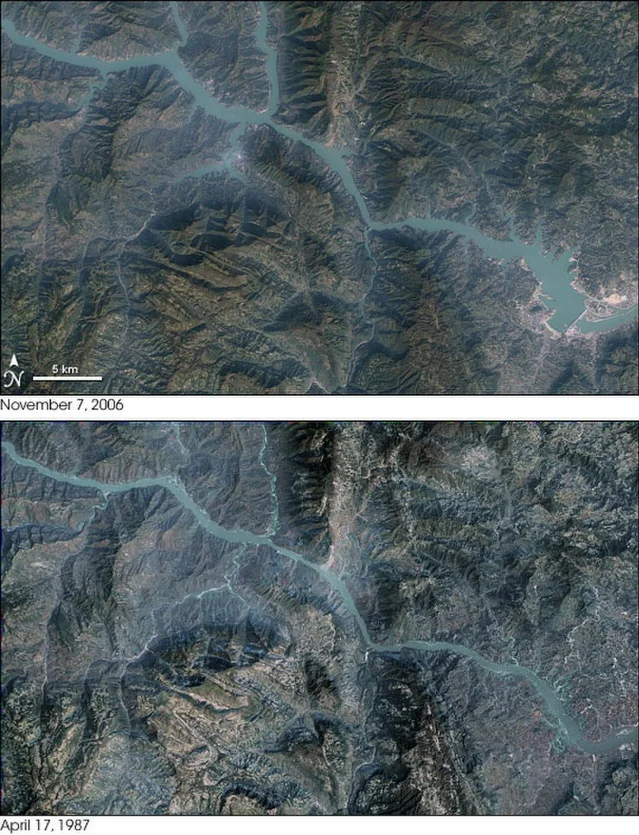
The reservoir's 39.3 km³ at full pool covers a surface area of 1,084 km² and stretches 660 km upstream, submerging 13 cities, 140 towns, and 1,350 villages, in whole or in part. 1 2 The official resettlement count reached 1.24 million people by June 2008; critics cited by Britannica place the actual figure closer to 1.9 million. 2
Resettlement was structured as forced relocation rather than voluntary migration: households received compensation and were assigned to new locations on higher ground or in receiving cities, predominantly in Chongqing and Hubei provinces. Outcomes were uneven. For younger residents, relocation to urban areas provided access to employment and education unavailable in the reservoir zone. For older residents — particularly farmers whose livelihoods depended on specific parcels of land — disruption was severe, and documented complaints about inadequate compensation were suppressed rather than adjudicated. The Chinese government acknowledged in a 2007 statement that the dam had "caused a series of ecological and social problems." 12
Archaeological rescue operations ran parallel to construction. The State Council allocated ¥505 million for excavation: archaeologists surveyed 723 sites, conducted surface collection at 346 additional sites, and recovered approximately 200,000 artifacts, of which around 13,000 were classified as having significant historical and cultural value. 1 Immovable structures — temples, pavilions, traditional residential compounds — were physically relocated to purpose-built preservation zones above the flood line.
Technical specifications
| Parameter | Value |
|---|---|
| Dam type | Straight concrete gravity dam |
| Crest elevation | 185 m above sea level |
| Height above rock foundation | 181 m |
| Crest length | 2,335 m |
| Crest width | 40 m |
| Base width | 115 m |
| Concrete volume | 27.2 million m³ |
| Steel | 463,000 tonnes |
| Earthwork and excavation | 102.6 million m³ |
| Reservoir length | ~660 km |
| Reservoir surface area | 1,084 km² |
| Total reservoir capacity | 39.3 km³ |
| Flood control storage | 22 km³ |
| Normal operating level | 175 m |
| Flood-season drawdown level | 145 m |
| Installed capacity | 22,500 MW (32 × 700 MW + 2 × 50 MW) |
| Design annual output | 88.2 TWh |
| Record annual output | 111.8 TWh (2020) |
| Rated turbine head | 80.6 m |
| Turbine runner diameter | 9.7 m (VGS) / 10.4 m (Alstom) |
| Generator rated output | 778 MVA |
| Transmission voltage | 500 kV AC |
| Ship lock chambers (each) | 280 m × 35 m × 5 m |
| Ship lock lift | 113 m total (5 steps) |
| Ship lift caisson | 120 m × 18 m × 3.5 m |
| Ship lift capacity | 3,000-tonne vessel |
| Construction period | December 1994 – July 2012 |
| Total project cost | ¥203 billion (~$31.8 billion) |
Legacy: what the dam changed in engineering practice
Turbine size records. The 700-MW, 10.4-m-diameter units at Three Gorges became the benchmark for subsequent large hydroelectric turbine design. The technology-transfer requirement in the manufacturing contracts — JV1 transferred to Harbin Electric; JV2 transferred to Dongfang Electric — built Chinese manufacturing capability that went on to produce the 1,000-MW, 10.7-m-diameter units used at Baihetan Dam, currently the world's largest individual hydroelectric generator. 1
Concrete thermal management at scale. The secondary air-cooled aggregate system and the quantified exit-temperature monitoring regime — 7°C target, computer-controlled production and delivery — have been documented and cited in subsequent Chinese mass-concrete work, including the Baihetan arch dam, which presented different thermal challenges (thinner but higher-stressed concrete in a double-curvature arch form).
Sediment cascade management as a design input. The recognition that a large reservoir requires upstream sediment capture, rather than in-reservoir management alone, is directly traceable to the Three Gorges experience. The Jinsha River cascade was partly motivated by sediment management and partly by power generation, but the operational integration of all six stations as a unified sediment- and flood-management system represents a shift from treating each dam as an independent project to treating a river basin as a system. AGU research confirming the 75% downstream sediment reduction has added rigorous quantification to what had been a design assumption. 10
Ship lock design limits are navigational, not hydraulic. The decision to size the ship locks for 10,000-tonne vessels at 280 m × 35 m × 5 m proved to be an underestimate of the navigation demand the reservoir would generate. The fact that a second, larger lock system was approved within 20 years of the first — with chamber dimensions of 6,680 m × 40 m × 8 m — reflects a lesson about demand forecasting that the engineers did acknowledge the risk but could not quantify accurately in advance.
The political precedent. Forbes contributor Wesley Alexander Hill, writing in July 2025 on the Yarlung Zangbo (Brahmaputra) hydro project that began construction that month, argued that "despite its numerous shortcomings, Three Gorges ultimately succeeded, and there is evidence that Chinese policymakers learned from its shortcomings." 12 The Yarlung Zangbo project — projected 300 TWh/year, roughly three times the Three Gorges output, at a cost exceeding $170 billion — is sited in a remote gorge where the river drops 2,000 m over 50 km, far from the population centers whose displacement drove the NPC opposition in 1992. Whether the engineering lessons have transferred as cleanly as the political ones will take another generation to know.
The dam has now been generating at full capacity for 13 years. Its structural body shows no indicators of distress. Its flood-control storage has performed within design parameters in every major event since 2010. Its navigation infrastructure is overloaded, its sediment problem is partially but not fully managed, and a second wave of construction — the expanded ship lock, the upstream Jinsha River cascade, the ongoing sediment bypass optimizations — is underway or approved. The physics Sun Yat-sen calculated in 1919 was correct. The consequences of converting 660 km of river into a reservoir are still being worked out.
Cover image: Three Gorges Dam, September 2009. Image from Three Gorges Dam — Wikimedia Commons
References
- 1Three Gorges Dam — Wikipedia
- 2Three Gorges Dam — Britannica
- 3Why Are There No Short Arch Dams? — Practical Engineering
- 4The Three Gorges Dam: Built at the Absolute Limit
- 53 Gorges Dam with InSAR Satellite Data — Casey Jones PE
- 6Keeping it cool at Three Gorges — International Water Power
- 7Three Gorges: How 40 Billion Tons of Water Shifted the Earth's Axis — Sabin Civil Engineering
- 8A Remarkable 2025 for World's Largest Clean Energy Corridor — SASAC
- 9China to construct second ship lock at Three Gorges Dam — Probe International
- 10Regulation of Particulate Organic Carbon by Cascade Mega Reservoirs — AGU Global Biogeochemical Cycles
- 11Induced seismicity by impoundment or hydraulic fracturing? — Frontiers in Earth Science
- 12History & Hydrology: What You Don't Understand About China's New Dam — Forbes
Add more perspectives or context around this Drop.